Whole-Scope Compliance Mapping for NZ Qualifications
22 July 2026 · 6 min read

A single NZQA-aligned qualification can split into dozens, sometimes hundreds, of unit standards — each one needing its own assessment, training material and assessor guide. Most New Zealand PTEs and ITOs still manage that pile document by document, and that's exactly where compliance drift, audit risk and staff burnout quietly build up.
When one qualification becomes forty compliance jobs
On paper, a qualification looks like one thing. In practice, it's a web. A Level 4 certificate might touch 20 unit standards; a diploma can touch 60 or more. Each standard carries its own assessment, its own training resource, its own assessor guide — and its own expiry date, review cycle and NZQA update history.
When teams manage that web one document at a time, the cracks show up fast:
- Updates get applied to some materials but not others, so a qualification ends up internally inconsistent.
- Nobody has a single view of which standards are current, which are close to expiry, and which have already changed.
- Course refreshes stall, because touching one qualification means opening dozens of separate files across different owners.
- Educators spend their week on document administration instead of teaching, moderating or mentoring.
None of this shows up as a single dramatic failure. It shows up as a slow accumulation of small gaps — the kind an NZQA audit or funding review eventually finds, and the kind that wears staff down long before that.
Treating the whole qualification as one traceable unit
The fix isn't a faster way to update one document. It's changing what you treat as the unit of compliance in the first place — from "this assessment" or "this unit standard" to "this qualification, end to end."
That's the thinking behind VETos's standards library. It holds unit standards alongside organisation-defined standards for off-framework or workplace learning in one place, with filters by level, expiry and compliance status. Instead of opening 40 separate folders to check where a qualification stands, a programme manager can see the whole scope — every standard it depends on — in one view.
Version control and audit logs across the whole standard
Underneath the library sits version control with a complete change history, plus audit logging through VETos's Audit Events feature, which gives managers visibility into activity across the workspace. That matters because an NZQA audit or internal review rarely asks about one document in isolation — it asks for a trail across a whole programme, showing what changed, when, and who approved it.
Dependent-content workflows that follow the standard, not the file
Because assessments and training materials are linked back to their source standards, a change at the standard level can trigger a workflow that flags every dependent document for review or regeneration. Nobody has to remember to manually track down every affected assessment or guide — the system already knows what depends on what.
Document-by-document vs whole-scope compliance
The practical difference between the two approaches shows up most clearly when something changes — a standard expires, gets revised, or converts to a new format.
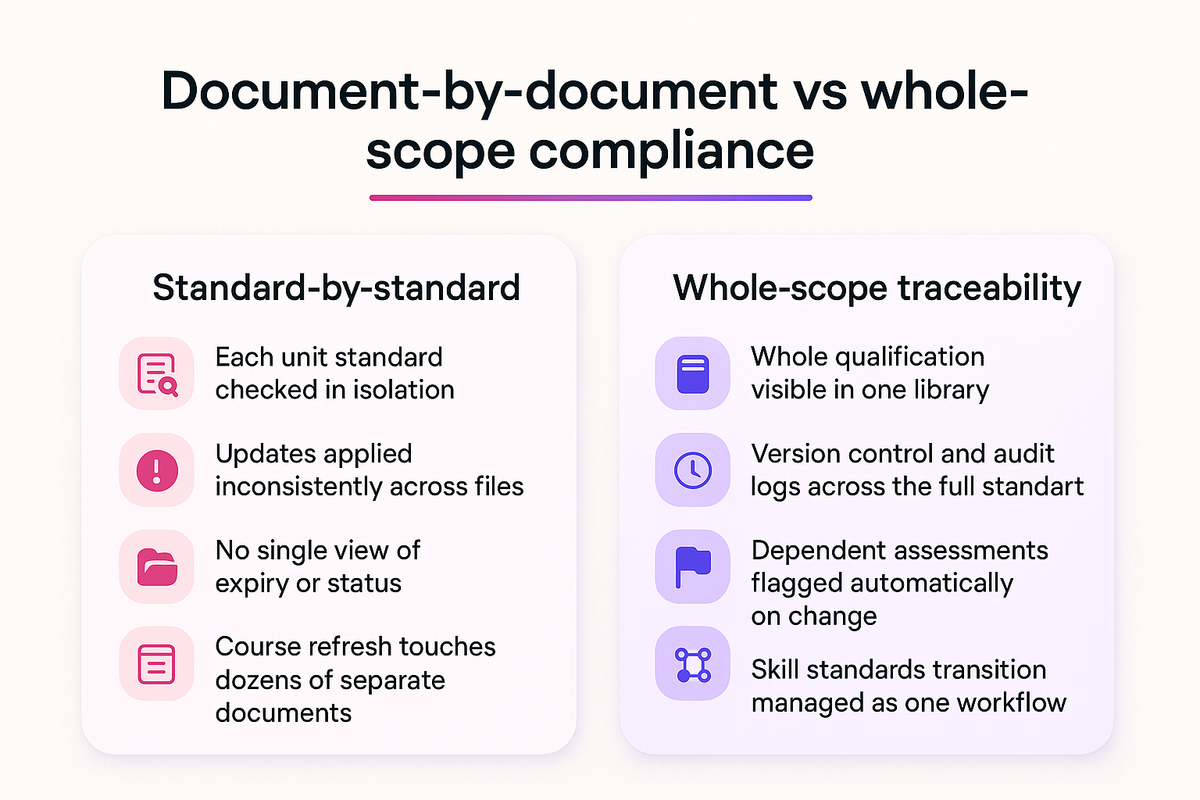
VETos is applying this same logic to NZQA's current shift from unit standards to skill standards: drafting materials against the new standards while upgrading existing unit-standard content as it converts, rather than treating the transition as a separate, standalone project.
Proof: what changes when scope-wide visibility replaces document chasing
The gap between the two approaches isn't theoretical. Mast Academy, a New Zealand PTE, reports that course creation work which used to take six weeks now takes minutes using VETos — a shift that only makes sense once you stop treating each unit standard as its own isolated task.
A regional New Zealand provider building a new Level 6 programme faced a similar scale problem: over 100 new assessments and learning guides, normally a three-month effort spread across multiple contributors. Working from a single qualification view rather than document by document changed how that workload was handled.
SupaHuman's own NZ-focused research describes ITOs and PTEs as "overwhelmed by the manual upkeep of NZQA-aligned resources," with the same update repeated across dozens or hundreds of unit standards, usually falling to whichever internal team has the least spare capacity. The named consequences — inconsistent compliance, slower course refreshes, staff burnout — are the direct result of managing a qualification as a pile of files instead of one traceable whole.
Key takeaways
- A qualification is really dozens (or hundreds) of unit standards, each with its own assessment, training material and assessor guide — treating them as separate tasks is where compliance risk builds.
- VETos's standards library covers unit standards and organisation-defined standards, filterable by level, expiry and compliance status, so a whole qualification's scope is visible at once.
- Version control and audit logging (via Audit Events) give an audit-ready trail across a full programme, not just a single document.
- Dependent-content workflows flag and regenerate affected assessments and training materials when a source standard changes, rather than relying on manual tracking.
- The same scope-wide approach is being used to manage NZQA's live transition from unit standards to skill standards.
Our take
Compliance risk in vocational education rarely arrives as one big failure — it accumulates in the gaps between documents nobody quite owns. Treating a qualification as a single traceable unit, rather than a folder of unrelated files, is less about speed for its own sake and more about closing exactly those gaps before an audit finds them. For NZ providers juggling frequent NZQA standard reviews, that shift in unit of management matters more than any individual feature.
FAQ
What is whole-scope compliance mapping in an NZ VET context? It means managing an entire qualification — every unit standard it draws on, plus the assessments, training materials and assessor guides linked to each — as one traceable set, rather than updating and checking each standard's documents in isolation.
How does VETos keep track of a whole qualification rather than single standards? VETos holds unit standards and organisation-defined standards in a central library, filterable by level, expiry and compliance status, with version control, audit logs and workflows that flag dependent assessments and training materials when a source standard changes.
Does this help with NZQA's move from unit standards to skill standards? Yes. VETos is drafting content against new skill standards while upgrading existing unit-standard materials as they convert, using the same traceability approach rather than treating the transition as a one-off project.
What NZ providers has this approach worked for? Mast Academy, a New Zealand PTE, reports course creation work that used to take six weeks now taking minutes. A regional provider building a Level 6 programme used the same approach to manage over 100 new assessments and learning guides that would normally take three months.
Is this only useful for large PTEs or ITOs with big programmes? The more unit standards a qualification touches, the more a fragmented approach costs in coordination and audit risk — so the benefit scales with programme size, but any provider managing multi-standard qualifications faces the same underlying problem.