Workforce Development Councils NZ: Assessment Reset
22 July 2026 · 7 min read

The two-year story of Workforce Development Councils isn't a review — it's a shutdown. All six WDCs were disestablished on 31 December 2025 and replaced by eight new Industry Skills Boards, and NZQA has used the handover to push assessment design from narrow unit standards toward broader skill standards, under a suite of rules that took effect on 19 January 2026.
What actually happened to the six WDCs?
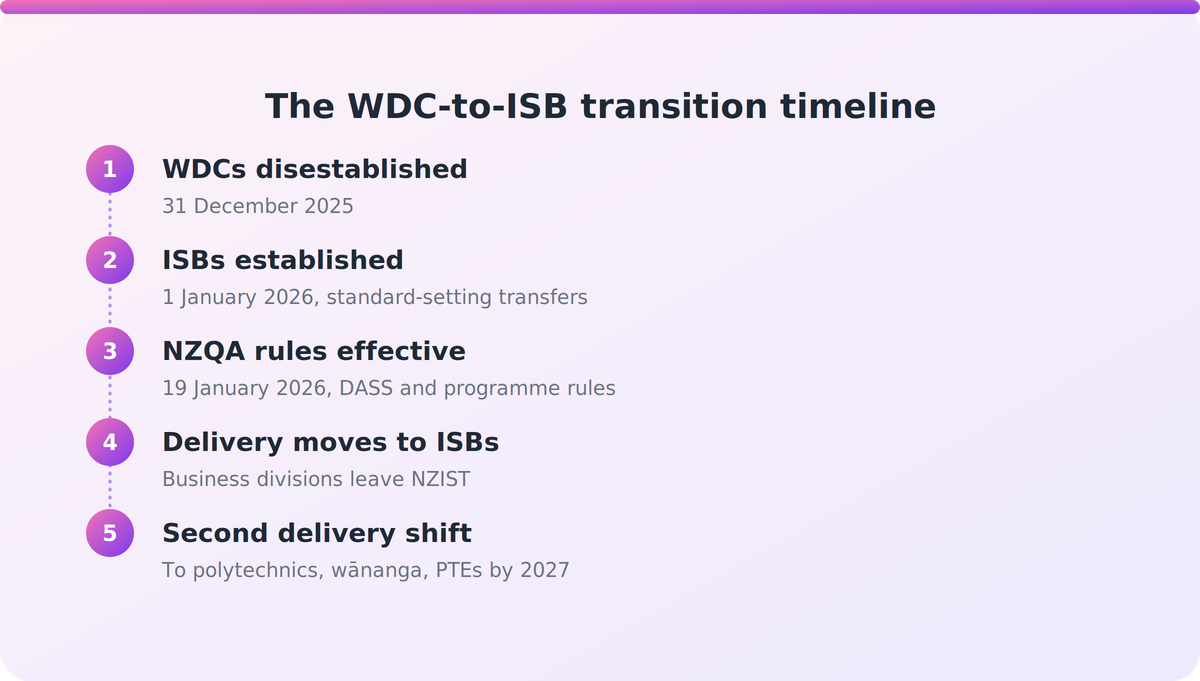
Toi Mai, Ringa Hora, Hanga-Aro-Rau, Waihanga Ara Rau, Muka Tangata and Toitū te Waiora all ceased to exist on 31 December 2025. Their standard-setting functions transferred on 1 January 2026 to eight new Industry Skills Boards (ISBs), as confirmed in the Tertiary Education Commission's vocational education update and the Ministry of Education's announcement on the new boards.
The split isn't tidy. In several cases, one former WDC's industry coverage now spans more than one ISB, which means providers can't assume their old sector contact and their new standard-setting body are the same organisation. If your assessment library was mapped to a WDC's coverage document, that map needs redrawing.
Why the real change is skill standards, not the ISB handover
The ISB transition is the visible story. The one that actually changes how you build assessments is quieter: NZQA is shifting the basic unit of assessment design from unit standards to skill standards.
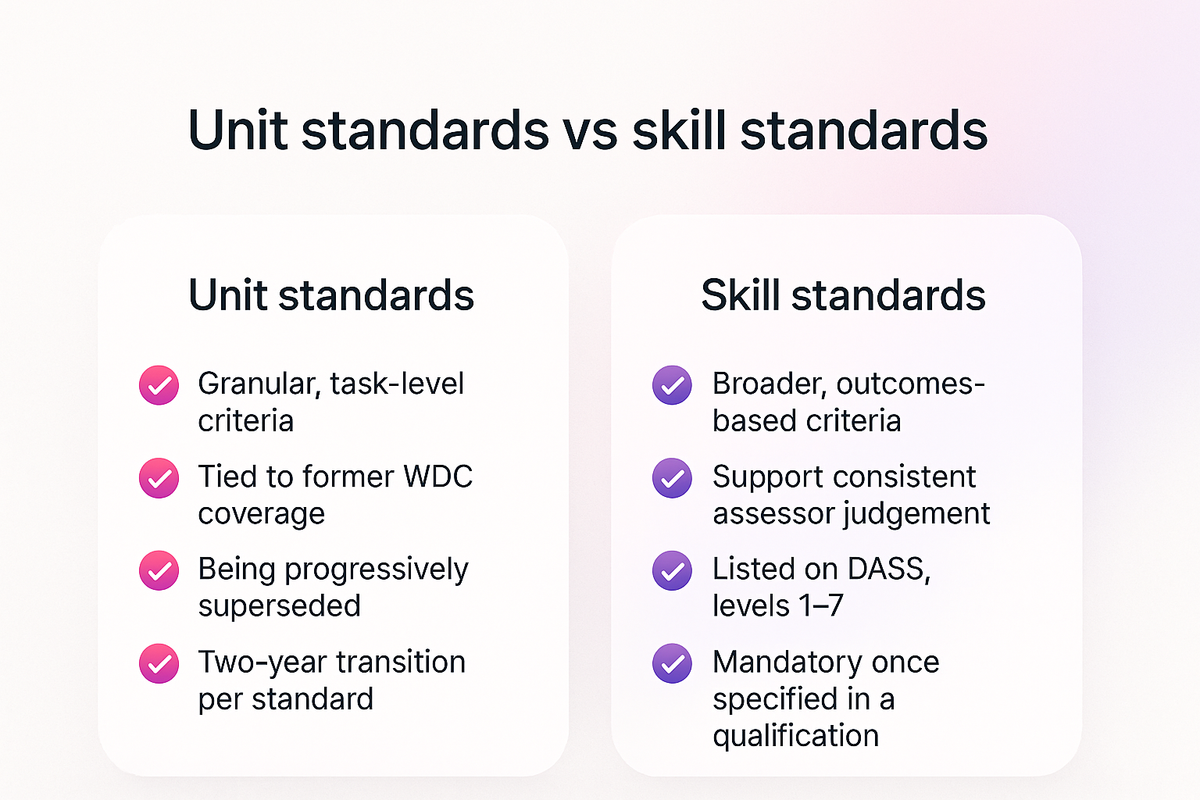
NZQA's Guidelines for listing skill standards on the Directory of Assessment and Skill Standards (DASS) confirm that assessment criteria must now "inform valid assessment design and consistent assessor judgements." Standard-setting bodies — now the ISBs — are expected to set two-year transition periods as unit standards are superseded.
Skill standards are broader and outcomes-based, rather than the granular, task-level criteria typical of unit standards. Once a qualification specifies a mandatory skill standard, every provider delivering that qualification has to use it — which changes how coverage gets proven at programme level, not just at assessment level.
What new NZQA rules took effect on 19 January 2026?
A cluster of NZQA rules commenced together, and providers need all three on file:
- DASS Listing and Operational Rules — governing how skill standards get listed and maintained on the Directory of Assessment and Skill Standards.
- Consent to Assess Against Standards Rules — updated consent requirements tied to the new standard types.
- Programme Approval, Recognition and Accreditation Rules 2026 — streamlining programme approval where a qualification consists entirely of skill standards, and removing the previous five-year maximum review period for qualifications.
Together these rules don't set a single changeover date. They set a framework for a multi-year, dual-track environment where unit standards and skill standards are both live at once.
A double transition: delivery ownership is still moving too
Assessment design isn't the only thing in flux. Work-based learning delivery is mid-transfer in its own right.
Business divisions moved out of NZIST (formerly Te Pūkenga) into the new ISBs in January 2026. A second shift is scheduled: that delivery moves again, into polytechnics, wānanga or PTEs, by 31 December 2027. TEC's ISB Coverage Consultation document also assigns capstone assessment development and external moderation of assessments explicitly to the ISBs — a move toward more summative, industry-endorsed assessment rather than purely modular unit-standard testing.
So for at least the next two years, assessment systems need to survive two more changes of who owns delivery, on top of the standard-setting handover that's already happened.
What dual-running actually means day to day
Because unit standards and skill standards will run side by side rather than swap over on one fixed date, the practical challenge is continuity, not a single migration project.
For a provider assessing against a unit standard that's already been superseded, the assessment content needs to be mappable forward to the new skill standard's assessment criteria without breaking moderation compliance in the meantime. That means:
- Tracking which unit standards each ISB has flagged for supersession, and by when.
- Keeping assessor guides current for whichever standard type is still live in a given programme.
- Proving coverage against DASS-listed skill standards (levels 1–7) once a qualification specifies them as mandatory.
- Maintaining moderation-ready evidence trails through at least two more changes of delivery ownership by 2027.
This is where a lot of assessment libraries built for a single, stable standard-setter start to strain. Content mapped once to a WDC's unit standards now needs a second layer of mapping to an ISB's skill standards, on a timeline the provider doesn't control.
Key takeaways
- All six former WDCs — Toi Mai, Ringa Hora, Hanga-Aro-Rau, Waihanga Ara Rau, Muka Tangata, Toitū te Waiora — were disestablished on 31 December 2025; eight new ISBs took over standard-setting from 1 January 2026.
- The bigger shift for assessment writers is NZQA moving from granular unit standards to broader, outcomes-based skill standards, with two-year transition windows rather than a single cut-over date.
- Three NZQA rule sets — DASS Listing and Operational Rules, Consent to Assess Against Standards Rules, and the Programme Approval, Recognition and Accreditation Rules 2026 — took effect on 19 January 2026.
- Work-based learning delivery is transferring twice: out of NZIST into ISBs in January 2026, then out of ISBs into polytechnics, wānanga or PTEs by 31 December 2027.
- ISBs now hold explicit responsibility for capstone assessment and external moderation, signalling a shift toward more summative, industry-endorsed assessment design.
Our take
The headline change — six councils gone, eight boards in — is the easy part to report and the least important part to plan around. The harder problem is that NZQA has opened a multi-year window where two different assessment architectures are valid at once, under a standard-setting landscape that's itself still settling. Providers who treat this as a single migration project will keep re-doing the work every time an ISB reassigns coverage or supersedes another unit standard. The ones who build assessment content that can be traced back to both a unit standard and its eventual skill standard, with moderation evidence intact either way, are the ones who won't be starting from zero in 2027 when delivery ownership shifts again.
FAQ
What replaced the Workforce Development Councils in New Zealand? All six WDCs — Toi Mai, Ringa Hora, Hanga-Aro-Rau, Waihanga Ara Rau, Muka Tangata and Toitū te Waiora — were disestablished on 31 December 2025. Eight new Industry Skills Boards took over standard-setting responsibilities from 1 January 2026.
When did the new NZQA assessment rules take effect? A suite of NZQA rules — the DASS Listing and Operational Rules, Consent to Assess Against Standards Rules, and Programme Approval, Recognition and Accreditation Rules 2026 — commenced on 19 January 2026.
What's the difference between unit standards and skill standards? Unit standards are granular, task-level standards tied to the previous WDC-led system. Skill standards are broader and outcomes-based, with assessment criteria designed to support consistent assessor judgement, and are listed on the Directory of Assessment and Skill Standards (DASS) at levels 1–7.
How long will unit standards and skill standards run in parallel? Standard-setting bodies — now the ISBs — are expected to set two-year transition periods as individual unit standards are superseded by skill standards, rather than a single fixed changeover date across the whole system.
Who is responsible for moderating assessments now — the former WDCs or the ISBs? TEC's ISB Coverage Consultation document assigns capstone assessment development and external moderation of assessments to the new Industry Skills Boards, a responsibility the former WDCs did not hold in the same explicit form.