Workforce Development Councils' Standards, Rewritten
24 August 2026 · 6 min read

New Zealand's vocational standards system changed hands on 1 January 2026: the six Workforce Development Councils are gone, replaced by eight new Industry Skills Boards now rewriting qualifications, endorsement rules and entire assessment frameworks. For PTEs, ITPs and Wānanga, the practical problem isn't knowing change is underway — it's keeping contextual, role-specific training content aligned to standards that are shifting faster than most content teams can update them.
From Six Councils to Eight Boards: What Actually Changed
The Workforce Development Councils were formally disestablished on 31 December 2025. From 1 January 2026, eight new Industry Skills Boards (ISBs) took over as the authoritative bodies for setting qualifications, credentials and standards across the vocational education system.
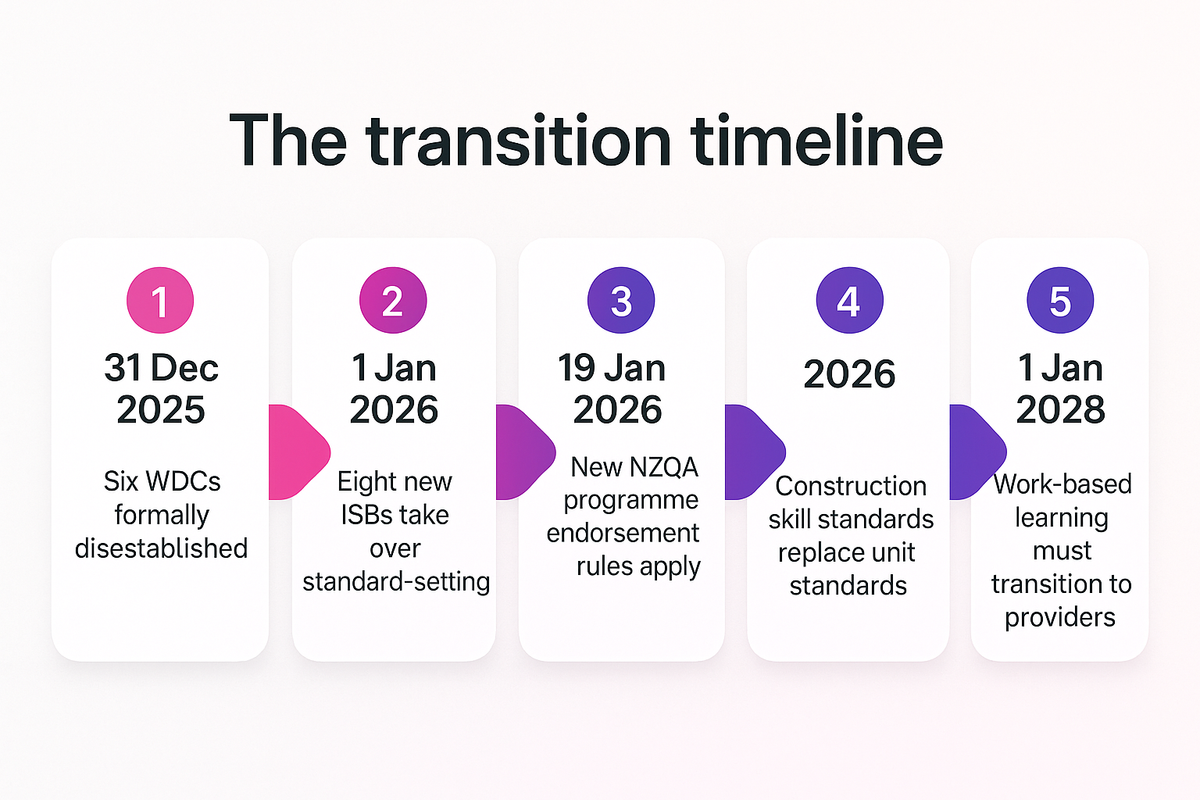
This isn't a rebrand. It's a structural handover, and it's landing on a compressed timeline:
- 31 December 2025 — the six WDCs cease to exist.
- 1 January 2026 — eight ISBs assume standard-setting responsibility.
- 19 January 2026 — new NZQA rules for programme endorsement against the NZ Qualifications Framework (NZQF) take effect.
- Through 2026 — sector-by-sector rewrites of standards and qualifications begin, at different speeds for different ISBs.
- 1 January 2028 — all ISB-affiliated work-based learning programmes and enrolments must transition to polytechnics, PTEs or Wānanga.
Each of those dates carries its own compliance and content implications, and providers are dealing with several at once.
Why the Coverage Split Matters for Your Content Library
If your programme material was mapped to a former WDC, it now needs re-checking — possibly against more than one new body. The old coverage didn't map cleanly onto the new one.
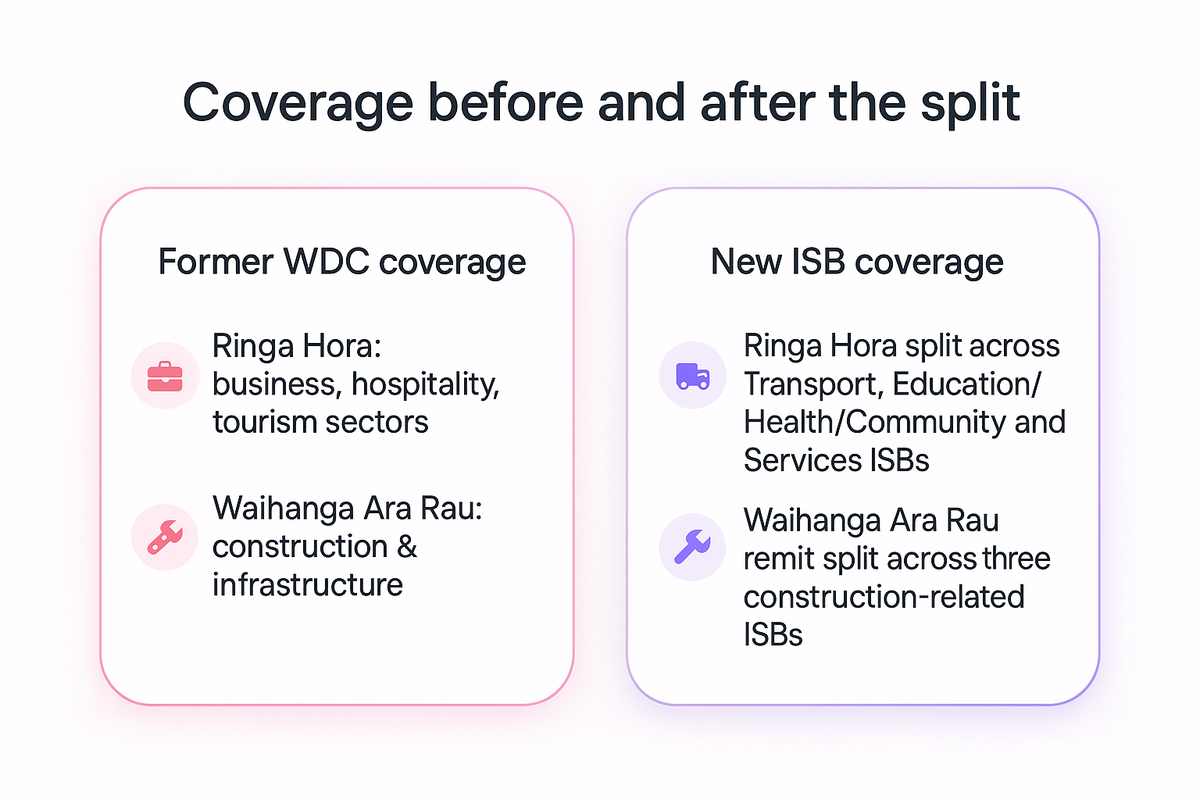
Two examples make this concrete:
- Ringa Hora's former industries (covering areas like business, hospitality and tourism) have been split across the Transport ISB, the Education/Health/Community ISB and the Services ISB.
- Waihanga Ara Rau's construction and infrastructure remit now sits across three separate ISBs.
For a training organisation with programmes touching any of these sectors, that means tracking guidance from multiple new bodies instead of one familiar council — and doing it while each ISB moves at its own pace.
NZQA's New Endorsement Rules: A Live Example of the Squeeze
NZQA's new rules for programme endorsement, effective 19 January 2026, directly change how providers get programmes approved against the NZQF during the transition. This isn't a future consideration — it's already the rule providers are working under.
Any provider with programmes in the endorsement pipeline needs to understand how the new process differs from the old one, and whether existing approvals still hold. Getting this wrong risks delays that ripple straight through to enrolment and delivery schedules.
Construction's Unit-Standard-to-Skill-Standard Shift
Construction is the clearest live example of how deep these changes go. Waihanga Ara Rau's successor ISBs are replacing existing unit standards with new skill standards starting in 2026 — not a light edit, but a rebuild of the entire assessment framework mid-transition.
That means providers in this sector are likely running parallel versions of content: the old unit-standard-aligned material for learners partway through, and new skill-standard-aligned material for new intakes. Maintaining both accurately, at the same time, is exactly the kind of workload that static, manually built content struggles with.
Budget 2026 Adds a Funded Pipeline of New Content
On top of the standards rewrite, Budget 2026 allocated $15 million for Industry Skills Boards to develop at least eight new industry-led secondary subjects. That's a funded pipeline of entirely new curriculum content that PTEs, ITPs/Te Pūkenga entities and Wānanga will need to build delivery capability for — on a timeline set by government funding decisions, not by any individual provider's content cycle.
The 2028 Deadline Is Already on the Calendar
It's worth flagging that 2026 isn't the end state. By 1 January 2028, all ISB-affiliated work-based learning programmes and enrolments must transition to polytechnics, PTEs or Wānanga. That's a second wave of structural and content disruption stacked on top of the standards rewrite already underway — and it's close enough that planning for it now isn't premature.
Independent commentary from outlets like FE News and The Conversation has described 2026 as a period of near-constant flux for the sector, with open questions on cross-ISB coordination and provider viability still unresolved. That's not alarmism — it's a reasonable read of a system being rebuilt while it's still running.
Key takeaways
- The six WDCs were disestablished 31 December 2025; eight new ISBs took over standard-setting from 1 January 2026.
- Former WDC coverage has been split across multiple new ISBs (e.g. Ringa Hora across three boards, Waihanga Ara Rau across three), so content mapping needs re-checking against more than one body.
- New NZQA programme endorsement rules apply from 19 January 2026, changing how programmes get approved against the NZQF during the transition.
- Construction is replacing unit standards with new skill standards from 2026, forcing providers to run parallel content versions during the changeover.
- A further deadline — 1 January 2028 — requires all ISB-affiliated work-based learning to transition to polytechnics, PTEs or Wānanga, meaning more disruption is still ahead.
Our take
The uncomfortable truth in this transition is that the bottleneck was never awareness — every provider watching this space knows the ISBs exist and knows standards are being rewritten. The bottleneck is production capacity: how fast can a training organisation actually turn a new skill standard into role-specific, assessable learning material, at the pace ISBs are now setting rather than the pace instructional design teams have historically worked at. Providers who treat this as a one-off documentation update will find themselves re-doing the same work in 2027 and again ahead of the 2028 transition deadline. The ones who come out ahead will be those who build a way to regenerate contextual practice and assessment content quickly enough to match a standards environment that, by every account so far, isn't planning to slow down.
FAQ
What replaced the Workforce Development Councils in New Zealand? Eight new Industry Skills Boards (ISBs) replaced the six Workforce Development Councils from 1 January 2026, taking over responsibility for setting qualifications, credentials and standards across the vocational education system.
When did the Workforce Development Councils actually close? The six WDCs were formally disestablished on 31 December 2025, with the eight ISBs assuming standard-setting authority the following day.
What changed with NZQA programme endorsement in 2026? NZQA introduced new rules for programme endorsement, effective 19 January 2026, which directly affect how training providers get programmes approved against the NZ Qualifications Framework during the transition.
Do PTEs and ITPs need to rebuild all their training content immediately? Not all at once, but sector-specific changes are already live — construction, for example, is replacing unit standards with skill standards from 2026. Providers need to track which of their programmes fall under an ISB that's actively rewriting standards now versus later.
What happens on 1 January 2028? All ISB-affiliated work-based learning programmes and enrolments must transition to polytechnics, Private Training Establishments (PTEs) or Wānanga by this date, marking a second phase of structural change beyond the 2026 standard-setting work.