The Workplace Competency Gap Every Head of Training Owns
9 September 2026 · 8 min read

A learner can pass every unit standard, satisfy internal moderation, and still walk onto a worksite unable to do the job. That gap isn't a moderation failure on paper — it's the exact risk NZQA's assurance system exists to close, and in New Zealand's vocational sector right now, the ground underneath that system is moving.
Why This Hits Your Desk
Assessment and moderation strategy sits with you. Not the board, not the compliance team — you own the design decisions that determine whether a 'competent' judgement means the same thing across every trainer, every cohort, every intake. NZQA's own language on moderation makes this your problem by definition: moderation exists to give employers and other stakeholders assurance that a credential means what it says. If a graduate can't perform on day one, that's not a footnote to your quality system. It's the thing your quality system was built to prevent.
Three things are converging on you at once. Trainer capability is under pressure after years of restructuring. Completion data suggests more learners are starting than are converting into workplace-ready outcomes. And the machinery behind national external moderation of industry unit standards is being rebuilt from 1 January 2026. None of this is hypothetical — it's the operating environment for the next 12 months.
What Moderation Is Actually Assuring
Training establishments need NZQA consent to assess against standards listed on the Directory of Assessment and Skill Standards, and every standard carries Consent and Moderation Requirements governing national external moderation. NZQA's national moderation principles frame the purpose plainly: assessment must be fair and must 'provide assurance to the standard-setting body, learners, employers, communities and other stakeholders that learners have achieved the learning outcomes for which they have been credentialed.'
Internal moderation is the mechanism that catches inconsistency 'within organisations, over time and between assessors' — it's what stops one trainer's pass meaning something different from another's. That's real, valuable work, and most Heads of Training run tight processes around it.
But consistency between assessors isn't the same claim as currency against the actual job. Two trainers can agree completely on what 'competent' looks like and both be judging against a version of the job that's five years out of date. Moderation proves internal agreement. It doesn't automatically prove the standard being agreed on still matches what employers need on the floor. That's the gap worth interrogating — not whether your moderation paperwork is clean, but whether the judgement calls underneath it are still current.
The Trainer Currency Problem
The people best placed to close that gap are trainers who still carry tacit, current workplace knowledge — and that's exactly the group under the most strain. Newsroom reported in May 2025 on 'change fatigue' across vocational education after years of successive restructuring, warning of the risk of losing experienced trainers and the disruption that flows on to learners.
Rebuilding that capacity from overseas isn't a quick fix either. Vocational Education Teacher doesn't appear on Immigration New Zealand's Long Term, Regional, or Construction and Infrastructure Skill Shortage Lists, so there's no fast-tracked pathway for recruiting trainer capability from offshore. If your experienced trainers walk, replacing their currency is slow, local, and expensive — right when the sector can least afford it.
What the Completion Numbers Are Telling You
Education Counts data for 2025 shows the 5-year apprentice qualification completion rate has fallen to 40%, down 3 percentage points, even as first-year retention has improved from 66% to 71%. Total trainee and apprentice numbers dropped 12% to 108,315 over the same period.
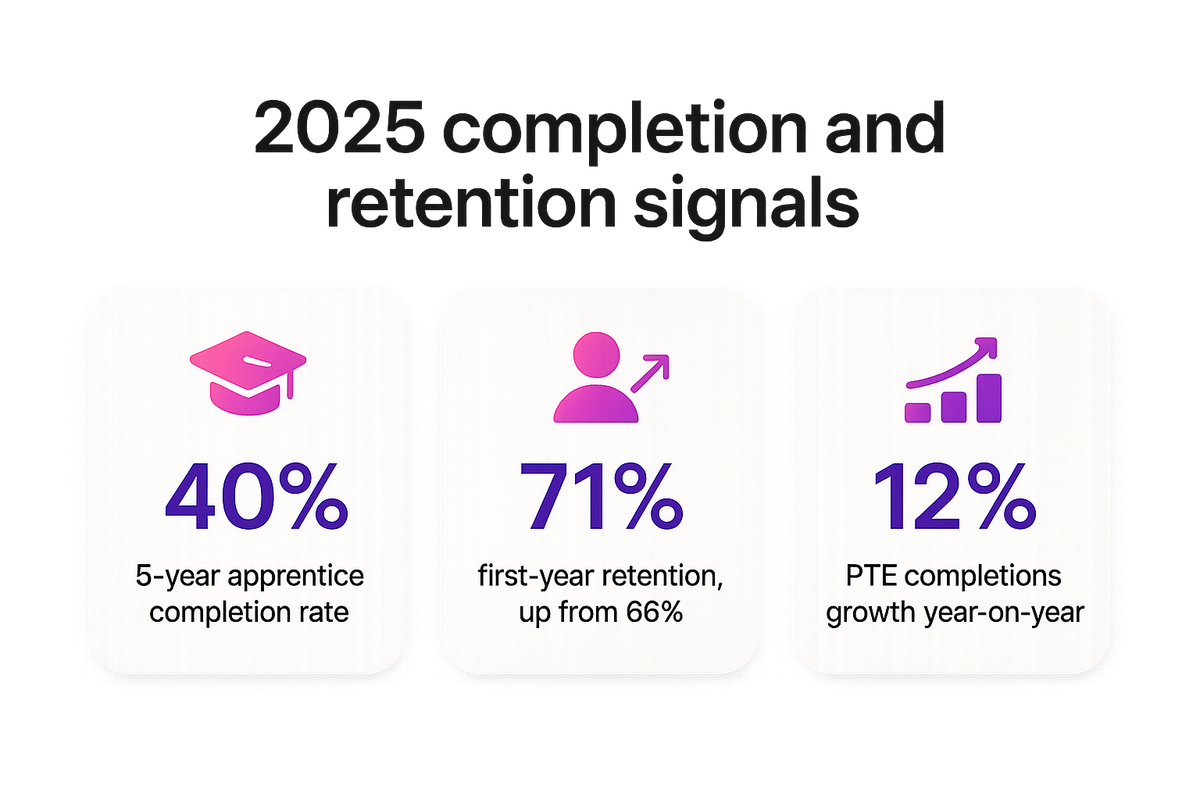
Read together, that's not a simple story of learners disengaging early. More people are staying in past year one — and fewer are converting that engagement into a completed, workplace-credentialed outcome down the track. Somewhere between enrolment and completion, the pipeline is leaking, and that's the stretch of the journey where classroom-to-workplace slippage has the most room to hide.
It isn't uniform. Private training establishments recorded the largest completions gains in 2025, up 12% year-on-year — a reminder to benchmark against your own delivery mode rather than assume the sector-wide trend applies to you directly. And the Office of the Auditor-General's 2024 review found completion rates for Māori and Pacific learners remain significantly behind non-Māori and non-Pacific learners — an equity dimension that has to sit inside any conversation about where assessment validity is actually breaking down.
The Ground Is Moving Again
Legislation passed in October 2025 disestablishes Te Pūkenga, transitioning delivery via NZIST and re-establishing ten regionally governed polytechnics. Workforce Development Councils, which manage national external moderation of industry unit standards, are being replaced by eight Industry Skills Boards from 1 January 2026.
That means the bodies setting and moderating the standards you assess against are themselves mid-handover. Expect transitional guidance, some inconsistency in response times, and a need to track which Industry Skills Board now owns moderation for your standards. Building slack into your validation calendar for this transition isn't optional — it's the realistic read of where the sector is right now.
Where to Look This Quarter
- Pull a sample of recently moderated assessments and check them against a current job description or task list from an employer, not just against each other.
- Ask every trainer when they last worked, observed, or shadowed in the industry they teach — and treat a long gap as a currency risk, not a personal criticism.
- Map your own completion and retention numbers against the national 40%/71% figures to see whether your leak point is early, mid, or late in the programme.
- Confirm which Industry Skills Board will own moderation for each standard you deliver against from January 2026, and flag any standards where guidance hasn't yet been issued.
- Cross-reference completion data by learner group to check whether the equity gap the Auditor-General flagged shows up in your own cohort.
Key takeaways
- Internal and external moderation prove consistency between assessors, not currency against real workplace tasks — the two are related but not identical, and a Head of Training has to test both.
- Trainer 'change fatigue' since 2020, plus the absence of Vocational Education Teacher from Immigration New Zealand's skill shortage lists, makes rebuilding trainer currency slow and largely a local, internal task.
- A 5-year apprentice completion rate of 40% (down 3 points) alongside first-year retention rising to 71% points to a mid-pipeline stall worth mapping cohort by cohort.
- PTEs' 12% completions growth in 2025 shows the pressure isn't uniform across the sector — benchmark against your own delivery type, not a single national average.
- Workforce Development Councils hand over national moderation of industry unit standards to eight Industry Skills Boards from 1 January 2026 — confirm ownership of your standards before that date, not after.
Our take
The instinct in a period of upheaval is to tighten paperwork — more sign-offs, more evidence templates, more audit trail. That's not wrong, but it treats the symptom. The real fix is building a feedback loop that runs from the workplace back into assessment design: talk to the employers your graduates go to, ask what day-one competence actually looks like this year, and check that against what your trainers are judging in the room. Moderation compliance tells you your assessors agree with each other. Only that outside loop tells you whether they're agreeing on the right thing.
FAQ
Does passing internal moderation mean a learner is workplace-ready? Not on its own. Internal moderation confirms assessors are judging consistently with each other and over time. It doesn't independently confirm the standard they're judging against still reflects current workplace practice — that check has to come from outside the moderation process itself, through direct contact with employers and current industry tasks.
How will the shift from Workforce Development Councils to Industry Skills Boards affect moderation? From 1 January 2026, the eight new Industry Skills Boards take over national external moderation of industry unit standards from Workforce Development Councils, as part of the wider legislative change disestablishing Te Pūkenga. Heads of Training should confirm which board now owns moderation for each standard they deliver, since guidance and processes are likely to be in transition.
Why is the apprentice completion rate falling while first-year retention is rising? Education Counts 2025 data shows first-year retention improved from 66% to 71%, but the 5-year completion rate fell to 40%. That combination suggests more learners are staying engaged early on but fewer are converting that engagement into a finished, credentialed outcome — pointing to a stall somewhere in the middle of the training journey rather than at entry.
What can a Head of Training do about trainer shortages given recruitment barriers? Because Vocational Education Teacher isn't on Immigration New Zealand's shortage lists, there's no fast-tracked overseas recruitment pathway, so rebuilding trainer capacity is largely a domestic task. Practical options include structured knowledge-sharing between senior and newer trainers, deliberate rotation back into industry to maintain currency, and workload reviews to reduce the risk of losing experienced staff to burnout.