Assessment Tools for Diverse Learner Cohorts in an RTO
18 October 2026 · 7 min read
One unit of competency often has to serve ESOL, LLN and workplace or RPL learners. Most RTOs respond by building three near-identical tools, then discover the real cost at validation: proving every version still covers the same elements and performance criteria. That proof rarely exists until someone builds it by hand.
Why do assessment tools for diverse learner cohorts drift apart?
It usually starts with good intentions. A trainer simplifies the wording for an ESOL group. Another adds numeracy scaffolding for an LLN cohort. A third rewrites tasks for workplace evidence. Each change is reasonable on its own.
The trouble is that nobody shares a reference point back to the unit. Wording, scaffolding and delivery format start to differ, and the versions slowly stop being the same tool.
The first draft isn't the hidden cost. Keeping every adapted version traceable back to the unit is.
What does that cost you at validation?
Under the Standards for RTOs 2025, assessment tools must be validated before use. Validation is where someone checks that coverage hasn't drifted between cohort variants.
That check goes badly when:
- each version has its own mapping, built by a different person at a different time
- the mapping describes the tool as it was first written, not as it is now
- RPL and workplace learners go through a lighter or separate process, which puts equivalence of evidence at risk
- the paper trail proving equal coverage gets assembled in a scramble before an audit
No regulator prescribes a fixed matrix format. But the mapping has to be accurate, complete and match the tool as it exists today. A stale matrix is worse than a plain one.
What's the alternative to building three separate tools?
Treat a cohort variant as a parallel version of one mapped source, not a separate build.
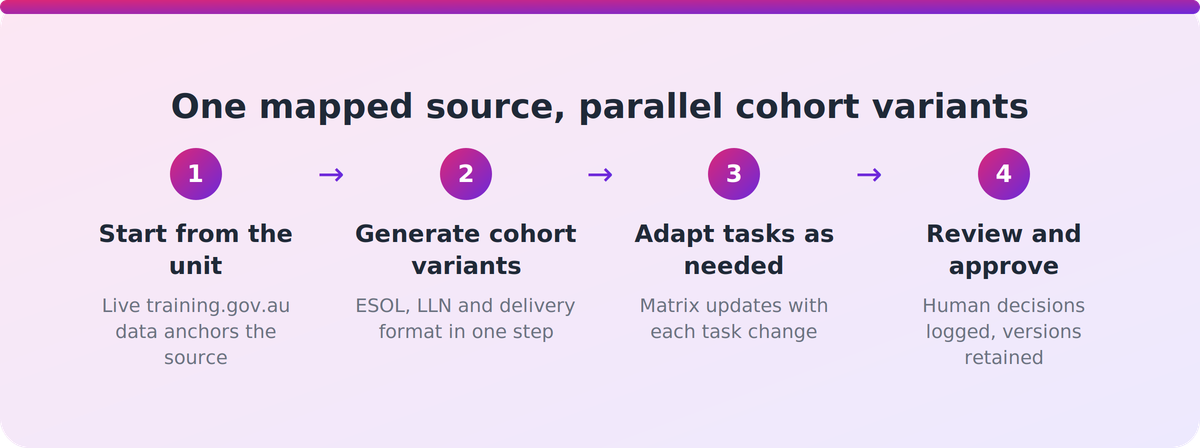
The unit of competency stays the anchor. ESOL support, LLN scaffolding and delivery format are changes applied to that source. Coverage then has one home, so a validator can compare versions against the same reference.
How VETos handles cohort variants
VETos (vet.supahuman.com) is built around this model. Specifically:
- Language support sits in the generation step. ESOL, LLN and multilingual support is part of the same step as delivery format (online, blended, face-to-face or print-ready). Variants are parallel versions from one mapped unit source.
- A mapping matrix comes with every tool. It's drawn from live training.gov.au data and works for both traditional and ASK-format units.
- The matrix records coverage per task. That covers elements, performance criteria, knowledge evidence and performance evidence.
- Adapting a task doesn't reset the mapping. Simplify the wording for ESOL or add a numeracy scaffold for LLN, and the matrix updates with the task rather than being rebuilt.
- The assessor guide and mapping document are produced together. That applies to standalone, clustered, grouped or fully integrated assessments, linked to scope items on the national training register. A human stays in the loop on every decision.
What keeps the whole set defensible over time?
Coverage isn't the only thing that drifts. Units get superseded, versions multiply and approvals go undocumented.
VETos holds a graph of the RTO's scope, with every unit, element, performance criterion and performance evidence requirement. Workflow covers assign, review, approve and lock. Every decision is logged and every version retained, so there's a version history to show a validator.
Superseded units are flagged automatically. You update the affected resources precisely instead of re-checking the whole catalogue. The VETos FAQ describes the assessment, study guide and training and assessment strategy as anchored to the same live regulatory graph, so a change on the register is known to everything grounded in it.
Industry Profiles help too. An RTO defines a sector or workplace context once, and every assessment and resource then reflects it. That makes the workplace variant less of a bespoke rewrite.
What does the evidence say?
We'll be straight about the limits. We have no named customer case study to quote and no published figures from our own pages, so we won't invent any.
What we can point to:
- Our own piece, ESOL, LLN & RTO Assessment Design: One Unit, Three Cohorts, describes the duplication and validation-drift problem and the parallel-version approach.
- Our buyer guide notes that AI can speed up mechanical work, such as drafting tasks, structuring a mapping matrix and generating parallel versions for different delivery contexts. It also says mapping must be accurate and complete whatever the format.
- An EduGrowth article from 21 July 2026 says VETos offers mapping at the click of a button and full validation bundles assembled in under an hour. That's a third-party claim, so test it in your own context.
This post covers three cohorts: ESOL, LLN and workplace/RPL. Your portfolio may have more, and the same logic applies.
How do you test whether your current approach holds up?
Pick one unit you deliver to more than one cohort. Then ask:
- Can you show, per task, which elements and performance criteria each version covers?
- Does that mapping match the tool as it stands today, not as first written?
- Would an RPL or workplace assessor collect evidence of the same standard as a classroom assessor?
- Could you rebuild the validation evidence without a week of manual cross-checking?
If any answer is "not sure", that's where drift is hiding.
Key takeaways
- The cost of cohort-specific tools isn't drafting. It's proving every version still covers the same unit requirements.
- Standards for RTOs 2025 require tools to be validated before use, so drift between variants shows up at validation.
- Generating cohort variants from one mapped source keeps coverage traceable.
- In VETos, the mapping matrix is drawn from live training.gov.au data and updates when a task is adapted.
- No regulator sets a fixed matrix format. Accuracy, completeness and a match to the actual tool are what count.
Our take
Most RTOs treat cohort adaptation as a writing job. We think it's a traceability job. The writing is the easy part, and AI is good at it. What separates a defensible portfolio from a fragile one is whether every variant can be tied back to the unit without heroics. Where RPL and workplace learners get a lighter path, the equivalence question deserves your attention first.
FAQ
Do ESOL, LLN and workplace learners need separate assessment tools?
Not necessarily separate builds. The unit's requirements are the same for every cohort. What changes is language support, scaffolding and delivery format. Treating variants as parallel versions of one mapped source keeps the requirements fixed while the delivery adapts.
What does validation check across cohort variants?
Under the Standards for RTOs 2025, assessment tools must be validated before use. In this context a validator checks that coverage hasn't drifted between versions, so each still addresses the unit's elements and performance criteria.
Does a regulator require a specific mapping matrix format?
No regulator prescribes a fixed format. The mapping must be accurate, complete and match the tool as it currently exists, including after any adaptation for a cohort.
What happens to the mapping when I adapt a task in VETos?
The matrix updates with the task instead of being rebuilt. It records which elements, performance criteria, knowledge evidence and performance evidence each task covers, drawn from live training.gov.au data.
Does VETos replace human judgement in assessment design?
No. The assessor guide and mapping document are produced together with a human in the loop on every decision. Workflow covers assign, review, approve and lock, with each decision logged.
Take a closer look
If you're weighing how to handle multiple cohorts, bring one real unit and your current tools. We'll show you how a parallel-version approach and its mapping matrix work on that unit. Start at vet.supahuman.com.